
Introduction
Marriage is one of the most important decisions in life. In Indian culture, marriage is traditionally considered not only a union between two individuals but also a relationship between two families. Before finalizing a marriage, many Hindu families consult a Vedic astrologer for Kundli matching, also known as Kundali Milan or Horoscope Matching.
Kundli matching is an ancient Vedic astrology practice used to assess the astrological compatibility of two individuals based on their birth charts. It traditionally examines factors related to emotional understanding, personality, family life, and marital harmony.
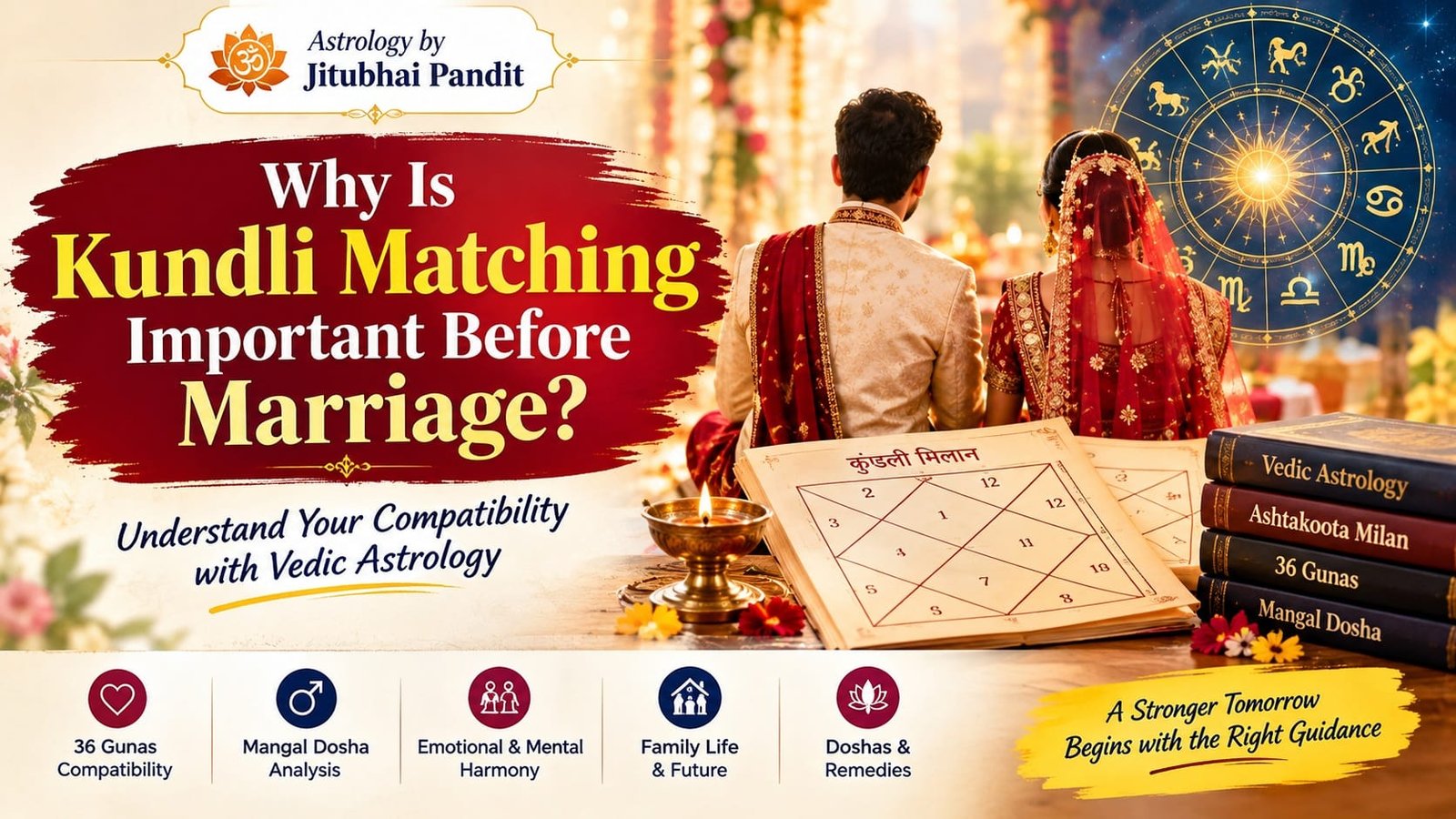
But why is Kundli matching considered important before marriage? What is the significance of the 36 Gunas, Mangal Dosha, and other astrological factors? In this guide, we will explore the importance of Kundli matching, its traditional methods, and how couples can use it as one part of their marriage preparation.
What Is Kundli Matching in Vedic Astrology?
Kundli matching is the process of comparing the birth charts of a prospective bride and groom to evaluate their compatibility according to Vedic astrology.
A birth chart, or Janam Kundli, is prepared using an individual’s date of birth, time of birth, and place of birth. It represents the positions of celestial bodies at the time of birth according to astrological calculations.
During Kundli Milan, an astrologer traditionally examines the Moon signs, Nakshatras, planetary placements, and other relevant chart factors to assess compatibility.
The primary purpose of this practice is to identify traditional astrological indicators that may be associated with married life and to help families discuss potential areas of concern before marriage.
Why Is Kundli Matching Important Before Marriage?
1. Understanding Astrological Compatibility
One of the main reasons families consider Kundli matching is to evaluate the astrological compatibility of two individuals.
In Vedic astrology, the Moon sign and Nakshatra are often considered important indicators when comparing birth charts. The traditional matching process examines whether the charts are considered compatible according to established astrological principles.
However, astrological compatibility should not be confused with a scientifically proven prediction of marital success. A healthy marriage also depends on communication, mutual respect, emotional maturity, and shared values.
2. Evaluating the 36 Gunas
The Ashtakoota system is one of the most widely known methods of Kundli matching. It evaluates eight traditional compatibility factors, collectively known as Kootas.
The total possible score is 36 Gunas.
The eight Kootas are:
- Varna: Traditionally associated with spiritual or personal compatibility.
- Vashya: Considered in relation to mutual influence and interpersonal dynamics.
- Tara: Examines the traditional relationship between the birth Nakshatras.
- Yoni: Associated with physical and instinctive compatibility in traditional interpretations.
- Graha Maitri: Evaluates the relationship between the planetary lords of the Moon signs.
- Gana: Considers traditional temperament classifications.
- Bhakoot: Examines the relationship between the Moon signs.
- Nadi: Traditionally associated with health, constitution, and family-related considerations.
Each factor carries a specific number of points, adding up to 36.
Traditionally, a score of 18 or more is often treated as an initial compatibility benchmark. However, the total score alone should not determine whether a marriage should proceed. Different astrological traditions may interpret the results differently, and a complete assessment considers the broader birth charts.
3. Examining Mangal Dosha
Mangal Dosha, also known as Manglik Dosha, is another commonly discussed factor during Kundli matching.
In Vedic astrology, Mangal Dosha is traditionally assessed through the placement of Mars in particular houses of the birth chart. The houses considered and the rules for interpretation can vary across astrological traditions.
Some astrologers examine both partners’ charts to determine whether the placements are considered compatible or whether traditional cancellation factors apply.
It is important to understand that Mangal Dosha is an astrological concept and is not scientifically established as a cause of marital conflict, separation, or other life events.
A responsible consultation should explain the relevant chart factors without creating unnecessary fear or pressuring a couple into expensive rituals.
4. Assessing Emotional and Mental Compatibility
Emotional understanding is essential for a successful marriage. In traditional Vedic astrology, the Moon is associated with the mind, emotions, and mental tendencies.
For this reason, astrologers often examine the Moon signs, Nakshatras, and relevant planetary relationships when comparing two Kundlis.
These interpretations may offer a traditional framework for discussing differences in temperament and expectations. However, a birth chart cannot reliably establish how emotionally mature, caring, or understanding a person will be in real life.
Couples should also discuss how they handle disagreements, express affection, manage stress, and support one another.
5. Considering Family Life and Long-Term Compatibility
Marriage involves more than romantic attraction. It may include shared responsibilities, financial decisions, family expectations, and long-term plans.
A traditional Kundli analysis may examine the seventh house, its ruling planet, Venus, Jupiter, and other relevant planetary placements, depending on the astrologer’s method.
These factors are interpreted within Vedic astrology as indicators related to marriage and partnership.
Nevertheless, an astrological reading cannot guarantee a happy marriage or predict every future challenge. Practical discussions about finances, careers, children, living arrangements, and relationships with extended family remain essential.
6. Identifying Traditional Doshas and Remedies
During Kundli matching, an astrologer may examine other traditional factors, including Nadi Dosha, Bhakoot Dosha, Grahan Dosha, or certain planetary combinations.
The significance of these factors depends on the specific charts and the astrological tradition being followed.
Some practitioners recommend mantras, prayers, puja, or other religious practices as traditional remedies. Such practices may provide spiritual comfort to people who value them, but they should not be presented as guaranteed solutions to marital problems.
Before considering a remedy, ask the astrologer to explain the astrological reasoning, the process involved, and any associated costs.
What Happens If Kundli Matching Is Not Favourable?
A low Guna score or the presence of a traditional Dosha does not automatically mean that a marriage will fail.
A complete astrological assessment may consider additional planetary placements, the strength of relevant houses and their lords, and traditional exceptions or cancellation rules. These factors can lead different astrologers to interpret the same charts differently.
More importantly, a marriage decision should never depend exclusively on an astrological score.
If two people respect each other, communicate openly, share compatible values, and are willing to work through difficulties, these real-world qualities deserve serious consideration.
Likewise, a high Guna score cannot guarantee happiness, loyalty, trust, or lifelong compatibility.
Is Kundli Matching Necessary for Love Marriage?
Kundli matching is commonly associated with arranged marriages, but many couples also choose it before a love marriage.
For couples who follow Vedic astrology, matching may be a way to understand traditional compatibility factors and address family concerns.
However, the same principles of mutual respect and informed decision-making apply to every marriage. Both partners should freely consent to the relationship and feel comfortable discussing important subjects such as career goals, finances, family expectations, and personal boundaries.
Kundli matching should be a source of guidance for those who value the tradition, not a means of controlling a partner or making decisions through fear.
How to Get Accurate Kundli Matching
For a meaningful traditional Kundli analysis, consider the following steps:
- Provide accurate birth details: Share the date, time, and place of birth for both individuals.
- Choose an experienced astrologer: Look for someone who explains the method and reasoning behind the interpretation.
- Request a complete assessment: Do not rely exclusively on the total Guna score. Ask about relevant planetary placements and traditional Doshas.
- Understand the limitations: Remember that astrology is a traditional belief system, not a scientifically validated method of predicting marriage outcomes.
- Discuss practical compatibility: Talk openly with your prospective partner about expectations, values, responsibilities, and future plans.
If the exact birth time is uncertain, inform the astrologer because some chart calculations may be affected.
Frequently Asked Questions About Kundli Matching
How many Gunas should match for marriage?
In the traditional Ashtakoota system, 36 Gunas are possible, and 18 or more is commonly used as an initial benchmark. However, the score should not be treated as a definitive judgment about a couple’s future.
Can a marriage succeed with a low Guna score?
Yes. A low score does not scientifically predict marital failure. Couples should consider their relationship quality, communication, values, and mutual commitment alongside any traditional astrological interpretation.
Is Mangal Dosha a reason to reject a marriage?
Not necessarily. Mangal Dosha is interpreted differently across astrological traditions. It should not be treated as a scientifically proven cause of marital difficulties or used as the sole reason to reject a prospective partner.
Is Kundli matching useful for love marriage?
Couples who value Vedic astrology may choose Kundli matching for traditional guidance. However, informed consent, mutual understanding, and practical compatibility are important in both love and arranged marriages.
Can Kundli matching guarantee a happy married life?
No. Neither Kundli matching nor any Guna score can guarantee marital happiness. A strong relationship requires trust, respect, honest communication, and shared effort.
Conclusion
Kundli matching remains an important tradition in many Hindu families because it offers a familiar framework for examining astrological compatibility before marriage. The Ashtakoota system, 36 Guna score, Mangal Dosha analysis, and other traditional chart factors are commonly considered during this process.
However, Kundli matching should complement practical relationship assessment rather than replace it. A successful marriage depends on mutual respect, emotional understanding, trust, shared responsibilities, and the willingness to grow together.
If you wish to explore Kundli Milan according to Vedic astrology, consider consulting a knowledgeable astrologer who explains the findings clearly, respects your decisions, and avoids fear-based predictions. Use the consultation as an opportunity for reflection while making your final marriage decision through informed and mutual consent.
About Astrology by Jitubhai Pandit
Astrology by Jitubhai Pandit offers Vedic astrology consultation for individuals and couples seeking traditional guidance on Kundli matching, marriage compatibility, and related astrological questions.
For consultation, contact Jitubhai Pandit.
Phone: 7230098835
Location: Surat, Gujarat, India
Astrological interpretations reflect traditional beliefs and should not replace personal judgment, relationship counselling, or professional medical advice where relevant.
For personalized guidance, consult our Best Astrologer in Oman for detailed Kundli analysis.