
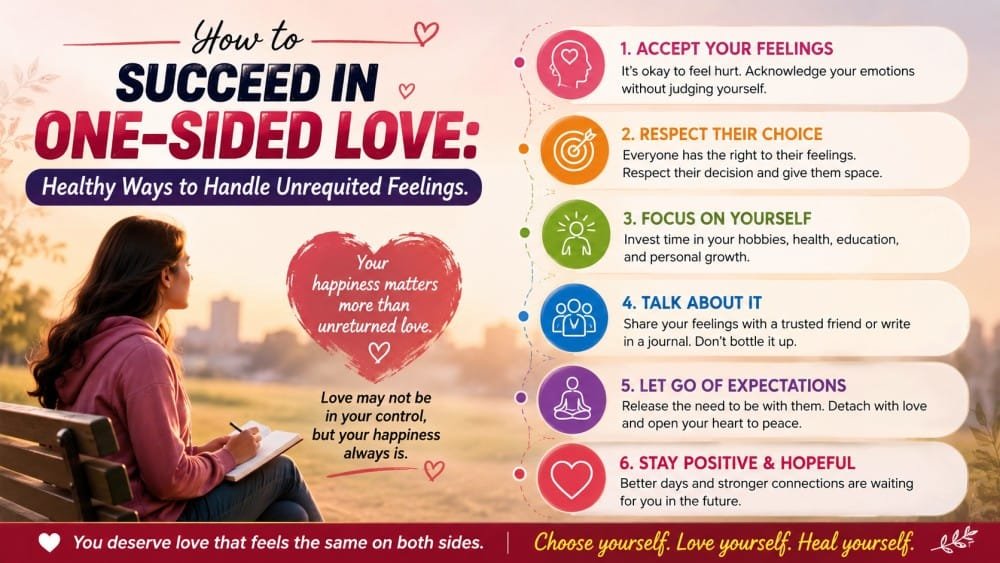
One-sided love can feel both beautiful and painful. You care deeply about someone, think about them often, and hope they may someday feel the same way. But when those feelings are not returned—or you are unsure where you stand—it can create confusion, sadness, and emotional stress.
Many people search for ways to find success in one-sided love. However, real success does not mean forcing someone to love you. Love cannot be controlled, persuaded, or earned through constant sacrifice. True success means handling your emotions with honesty, confidence, patience, and self-respect. It means giving your feelings a fair chance while also protecting your peace of mind.
Here are practical and healthy ways to deal with unrequited love.
1. Accept Your Feelings Without Feeling Ashamed
The first step is to accept that your feelings are real. Loving someone who does not know how you feel, or does not return your feelings, does not make you weak. It simply makes you human.
Do not judge yourself for becoming emotionally attached. Instead, acknowledge your feelings calmly. Ask yourself what you truly like about this person. Is it their personality, kindness, confidence, shared interests, or the way they make you feel?
Understanding your emotions helps you separate genuine affection from fantasy or loneliness. Sometimes, we become attached to the idea of a person rather than who they really are. Being honest with yourself is an important first step toward emotional clarity.
2. Get to Know the Person Naturally
If you want a meaningful connection, begin by building a comfortable and respectful friendship. Avoid rushing into dramatic declarations of love before you know the person well.
Talk to them naturally. Ask about their interests, goals, hobbies, and opinions. Listen carefully when they speak. Shared conversations can help you understand whether you genuinely connect with them or whether your feelings are based mainly on attraction.
Do not pretend to be someone else to impress them. A relationship built on a false version of yourself cannot bring long-term happiness. Be polite, kind, and authentic. The right person will appreciate your real personality.
3. Improve Yourself for Your Own Happiness
One of the best ways to handle one-sided love is to focus on personal growth. This does not mean changing yourself only to attract someone. It means becoming happier, stronger, and more confident for your own life.
Work on your health, education, career, communication skills, and hobbies. Spend time doing things that make you feel capable and fulfilled. When you have goals and a meaningful routine, you are less likely to make one person the center of your entire emotional world.
Confidence is attractive, but more importantly, it protects your self-worth. Your value does not depend on whether one particular person chooses you.
4. Express Your Feelings Clearly and Respectfully
If you have built a genuine connection and feel ready, it is usually better to express your feelings honestly than to stay trapped in uncertainty for years. You do not need a perfect speech. Keep it simple, calm, and respectful.
You might say: “I value our connection, and I have started to feel more than friendship. I wanted to be honest with you, but I also respect whatever you feel.”
This approach gives the other person space to respond without pressure. Avoid emotional ultimatums, repeated messages, or making them feel responsible for your happiness. Honest communication is healthy; pressure is not.
Remember, sharing your feelings is a sign of courage. Their response may not be what you hoped for, but clarity is still better than endless guessing.
5. Respect Their Answer and Boundaries
This is the most important rule in one-sided love. If the person says they do not feel the same way, respect their decision completely. A “no,” hesitation, silence, or request for distance should be taken seriously.
Do not try to convince them through gifts, constant attention, jealousy, or emotional pressure. These actions rarely create love and may damage trust. Real affection must be freely given.
Respecting someone’s boundaries also shows maturity and self-respect. You can be disappointed without being disrespectful. Their feelings are valid, just as yours are.
6. Do Not Make Them Your Entire World
When you love someone deeply, it is easy to spend all your energy thinking about them. You may replay conversations, check their social media, or imagine future possibilities. Over time, this can become emotionally exhausting.
Create balance in your life. Spend time with friends and family. Continue your studies or work. Exercise, travel, read, learn a new skill, or pursue a hobby. A full life makes emotional challenges easier to manage.
Love should add beauty to your life, not take away your identity. The healthiest relationships happen when two people bring their complete selves together—not when one person loses themselves trying to be loved.
7. Avoid Comparing Yourself to Others
It can hurt when the person you like seems interested in someone else. You may start comparing your looks, career, personality, or social status with another person. This comparison can damage your confidence.
The truth is that attraction is personal. Someone not choosing you does not mean you are less attractive, less worthy, or less lovable. It only means that the connection was not mutual.
Instead of asking, “What is wrong with me?” ask, “What can I learn from this experience?” Use the situation to understand your needs, boundaries, and hopes for future relationships.
8. Know When to Let Go
Sometimes, the greatest success in one-sided love is learning to let go. If your feelings are not returned and staying close causes ongoing pain, creating distance may be necessary.
Letting go does not mean your love was meaningless. It means you are choosing peace over constant emotional struggle. You can appreciate what you felt while accepting that the relationship may not be meant to happen.
Reduce unnecessary contact if it helps you heal. Avoid checking their updates repeatedly. Give yourself time to process your emotions. Healing is not instant, but it becomes easier when you stop feeding false hope.
9. Seek Support When You Need It
You do not have to handle emotional pain alone. Talk to a trusted friend, family member, or counselor if your feelings are affecting your sleep, work, confidence, or mental health.
Sharing your thoughts with someone supportive can make the burden feel lighter. A counselor can also help if you feel stuck in obsessive thoughts, anxiety, or sadness. Seeking support is a healthy choice, not a weakness.
Conclusion
Success in one-sided love is not about making someone fall in love with you. It is about expressing yourself honestly, respecting their freedom, and protecting your own heart.
If your feelings are returned, build the connection slowly with trust and mutual respect. If they are not, allow yourself to heal and move forward with dignity. The right love will never require you to abandon your self-respect, peace, or identity.
In the end, the most important relationship you will ever build is the one you have with yourself.
For personalized guidance, consult our Astrologer in Dubai for detailed Kundli analysis.